
Best Archival Scrapbook Supplies for Photos and Keepsakes
Choose scrapbook albums, pages, sleeves, corners, pens, boxes, and supports by documented materials and preservation job rather than vague labels.
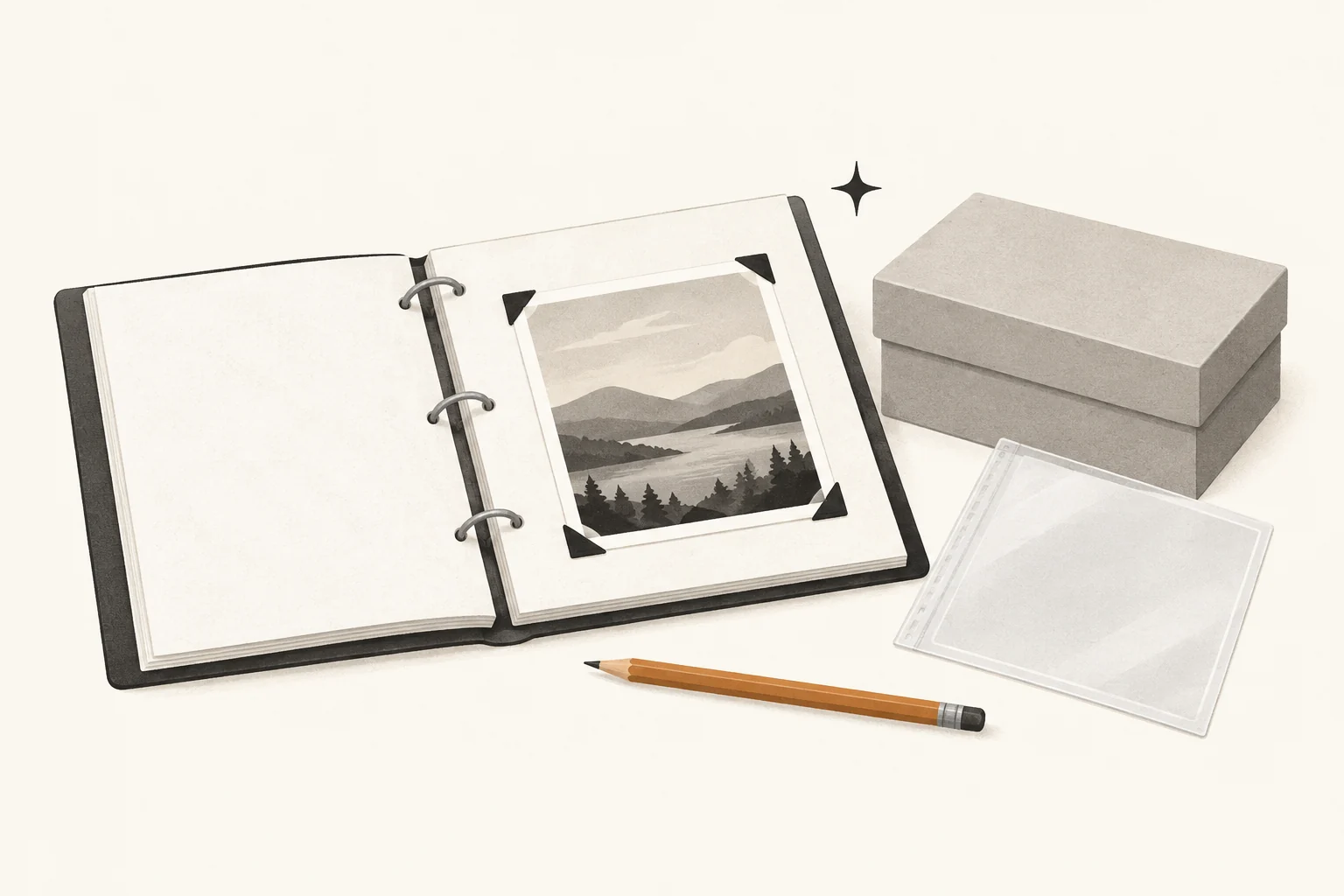
Disclosure: Legacy Memory Book may earn a commission if you buy through links on this page, at no extra cost to you. Recommendations are based on the stated criteria, reader fit, limitations, and preservation or privacy needs—not commission rate. No affiliate tracking links are active in this draft.
The short answer: The best archival scrapbook supplies are chosen by material specification and job, not by an “archival” badge. For photographs, look for acid-free, lignin-free paper and board and enclosures that have passed the Photographic Activity Test (PAT). Choose uncoated polyester, polyethylene, or polypropylene plastics; avoid polyvinyl chloride (PVC), sticky “magnetic” album pages, rubber cement, ordinary tape, staples, and rubber bands.
For an irreplaceable original, the safest scrapbook supply may be a scanner. Store the original in a documented enclosure and put a good copy in the book. The existing guide to preserving photographs in a memorial scrapbook explains the wider handling decision. This approach keeps the book usable without asking an old photograph, brittle letter, or unique recipe card to survive repeated page turning.
Quick buying list by job
| Job | Recommended type | Documentation to require | Skip when |
|---|---|---|---|
| Hold photographs in a book | Polypropylene or polyester pocket pages; paper pages with corners | Plastic type; PAT for direct photo contact | The page is PVC, self-stick, or unspecified plastic |
| Mount a photograph without adhesive contact | Polypropylene/polyester corners | Exact plastic; adhesive stays behind corner | The item is curled, flaking, or too heavy |
| Support captions and layouts | Acid-free, lignin-free heavyweight paper | Fiber/pH information; PAT if touching photos | The paper is dyed, glittered, coated, or undocumented |
| Write captions | Soft graphite pencil on enclosures; suitable pigment pen on tested paper | Manufacturer ink specification; test on scrap | Writing directly on a unique original is avoidable |
| Protect loose photographs | PAT-passed polyester, polyethylene, or polypropylene sleeves | Plastic type, coating status, PAT | Storage is hot or extremely humid |
| Store originals and the finished album | Well-fitting preservation box | Acid/lignin-free board; PAT for photographs | The box is overfilled or too large to support contents |
| Add thick keepsakes | Separate enclosure or photographed copy | Fit, support, and material specification | The object strains the binding or presses against photos |
How we evaluated supplies
This guide does not rank by brand popularity or temporary price. It applies guidance from the Library of Congress and U.S. National Archives, then checks whether a manufacturer or specialty supplier states the material, construction, and relevant test information.
The criteria are:
- Direct-contact safety: exact paper fiber or plastic type, not “photo safe” alone.
- PAT evidence: especially for materials touching photographs.
- Reversibility: the item can be removed without adhesive, scraping, solvent, or tearing.
- Physical support: pages, sleeves, and boxes fit without bending or overstuffing.
- Environmental fit: transparent plastics are not used where persistent high humidity creates sticking risk.
- Plain labeling: future family members can identify materials without writing on originals.
- Availability without lock-in: specialty preservation suppliers are included even when there is no affiliate relationship.
The PAT, defined in ISO 18916, is an accelerated test for interactions between enclosure materials and photographic images. A PAT result does not make an item permanent or suitable for every process, but it is stronger evidence than an undefined “archival quality” label.
1. PAT-passed pocket pages — best for photographs handled often
Pocket pages made from uncoated polypropylene or polyester let people view photographs without touching the image surface. They also make it possible to rearrange a book without peeling an original from a page.
Gaylord Archival lists polypropylene album pages with PAT information, while Print File makes photograph pages in several formats. Buy the pocket size that matches the print; a loose photograph can slide and abrade, while an undersized pocket can bow it.
Best for: Standard-size prints, duplicate prints, and collections that relatives will handle regularly.
Avoid if: The photograph has flaking media, a sticky surface, severe curl, or will be stored in persistently high humidity. Ask a photograph conservator about unusual processes or damage.
Strengths
- No adhesive touches the photograph.
- Images remain visible without removal.
- Pages can be reordered in a suitable binder.
- Pocket formats provide consistent physical support.
Limitations
- A pocket page can encourage overfilling with several prints.
- Plastic creates glare.
- Unsuitable storage conditions can cause photographs to stick to smooth plastic.
- The binder itself still needs adequate support and a fitted box.
What to verify before buying: “Polypropylene,” “polyester,” or “polyethylene” is stated; the product is uncoated; the exact page has passed the PAT; and the hole pattern fits the chosen binder.
Verdict: Pocket pages are the easiest safe starting point for a non-crafty family. Choose them over self-stick pages, then place longer stories on facing paper pages.
2. Polypropylene or polyester photo corners — best for a traditional page
Photo corners hold a print while keeping adhesive off its surface and back. Lineco polypropylene mounting corners are one documented example: the manufacturer identifies the plastic and states that the adhesive sits on the corner rather than the artwork.
Corners should match the print’s weight and remain fully supported by the page. Do not force a curled or brittle photograph flat. If the object springs against the corners, place a copy in the album and store the original separately.
Best for: Flat prints on strong, acid-free and lignin-free album leaves.
Avoid if: The photograph is warped, cracked, flaking, heavy, or likely to be removed frequently.
Strengths
- Adhesive does not touch the image.
- The print can be removed later.
- Traditional page appearance leaves room for captions.
- Different corner sizes can support different print weights.
Limitations
- Small corners can release thick or curled prints.
- Misalignment can strain a print.
- A poor page substrate can still discolor or weaken.
- Pressure-sensitive adhesive remains in the album even though it does not touch the photograph.
What to verify before buying: The plastic type is stated, the corner is large enough, and the adhesive area remains completely outside the photograph.
Verdict: Corners are the best reversible-looking mount for sound, flat prints. Practice placement with a copy before mounting a unique original.
3. Heavy acid-free, lignin-free album paper — best page foundation
The Library of Congress recommends acid-free and lignin-free paper and a stock heavy enough to support the mounted material. “Acid-free” alone is incomplete: paper can contain lignin, dyes, coatings, or other additives that age poorly.
Choose neutral white, cream, or a documented undyed stock. Bright colour, glitter, flocking, unknown printed backgrounds, and optical effects add variables beside old photographs and documents. If a supplier cannot identify the paper, use it only for a disposable decorative layer that does not touch or enclose an original.
Best for: Captions, copied letters, printed stories, and flat photographs held with corners.
Avoid if: The product relies only on an “archival” logo with no material information.
Strengths
- Supports text-rich layouts and provenance notes.
- Can be replaced or reordered in an expandable binder.
- Heavy stock reduces sagging beneath mounted items.
- Plain surfaces keep attention on stories and photographs.
Limitations
- Paper alone does not shield photographs from handling.
- Buffered and unbuffered papers are not interchangeable for every photographic process.
- Added interleaving can overfill a binding.
- Dark or dyed papers may transfer or obscure condition changes.
What to verify before buying: Acid-free and lignin-free construction, adequate weight, no unstable colorants or coatings, and PAT evidence when the sheet will contact photographs.
Verdict: Treat the page as structure, not decoration. A strong plain sheet with clear captions usually outlasts an elaborate but undocumented craft paper.
4. Soft graphite and documented pigment pens — best for labels and captions
The National Archives recommends labeling the enclosure before inserting the photograph. When direct marking is unavoidable on a paper print, it advises a No. 2 or softer pencil along the reverse edge, not across the image area.
For captions on album paper, Sakura Pigma Micron is a widely available documented pigment pen. Sakura describes the ink as permanent, fade-resistant, chemically stable, and suitable for non-coated paper. That is a manufacturer claim, not permission to write on every historical object.
Best for: Caption cards, paper album leaves, sleeve labels, indexes, and provenance notes.
Avoid if: You are tempted to write across the back of a fragile, resin-coated, cracked, or valuable original.
Strengths
- Graphite labels are simple and reversible on paper enclosures.
- Pigment pens provide readable captions on tested album stock.
- A consistent labeling system can link originals, scans, and book pages.
Limitations
- “Archival ink” does not guarantee compatibility with every surface.
- Wet ink can transfer to facing material.
- Fine pens may emboss soft paper if pressed hard.
- A label on the original can still alter it.
What to verify before buying: Intended surface, pigment rather than vague “permanent” ink, dry-time behavior, and a successful test on scrap from the same paper batch.
Verdict: Write on the enclosure or page whenever possible. Give each item a short ID that also appears in the digital filename and caption record.
5. PAT-passed polyester sleeves — best visibility and handling support
For individual prints, letters, and flat paper items that need handling support, a clear L-sleeve or envelope can be useful. Gaylord’s polyester photograph sleeves identify the material and state that the specific product passed the PAT. Archival Products also lists PAT-passed polyester sleeves.
Transparent polyester is more rigid than polypropylene and gives clear viewing, but it does not block light. An opaque paper envelope may be better for material that is rarely viewed, while a polyester sleeve suits an item consulted often.
Best for: Frequently viewed photographs or documents that benefit from support and clear access.
Avoid if: The surface is flaking, tacky, friable, or stored where humidity may remain high.
Strengths
- Clear viewing reduces direct handling.
- Rigid film supports thin or torn paper during movement.
- PAT-documented products provide stronger material evidence.
- Sleeves can be grouped in a fitted box.
Limitations
- No protection from light.
- Static can be undesirable near loose or flaking media.
- Open edges still admit dust if stored poorly.
- Sleeve dimensions must fit without squeezing or excess movement.
What to verify before buying: Uncoated polyester, exact dimensions, PAT result, and an opening that allows insertion without flexing the item.
Verdict: Use a sleeve to reduce handling, then place it in a supportive folder or box. A sleeve is one layer, not the whole storage system.
6. A fitted preservation box — best for originals and finished albums
A well-fitting box limits light, dust, and accidental handling. The Library of Congress recommends storing albums flat in preservation-quality boxes, while the National Archives advises acid-free, lignin-free or buffered board and PAT-passed housings for photographs.
Archival Methods drop-front boxes are one documented example of acid-free, lignin-free buffered board. A drop front reduces the need to lift a fragile stack over a high box wall. Gaylord, Hollinger Metal Edge, University Products, and Lineco also sell preservation housings; compare the exact specification, not the supplier name alone.
Best for: The completed album, separately sleeved originals, letters, and oversized flat material.
Avoid if: The box is so large that objects slump, or so full that removal scrapes edges.
Strengths
- Adds protection from light, dust, and handling.
- Keeps related originals and documentation together.
- A fitted box physically supports an album stored flat.
- Drop-front designs ease removal of flat items.
Limitations
- A box cannot correct heat, damp, pests, or a flood-prone location.
- Buffered board is not ideal for every sensitive photographic process.
- Oversized boxes need spacers or folders for support.
- A heavy box becomes a handling hazard.
What to verify before buying: Internal dimensions, board composition, PAT status for direct photo storage, lid/drop-front design, and whether the loaded box can be moved safely.
Verdict: Buy the box after measuring the album and enclosures. Store it inside the living area of the home, away from pipes, vents, exterior damp, attics, and basements.
7. Copies and separate enclosures — best for bulky or fragile keepsakes
Pressed flowers, medals, jewelry, folded documents, locks of hair, badges, and thick cards can distort pages and press against photographs. The best “attachment material” for these objects is often no attachment at all.
Photograph or scan the object, put that image and its story in the album, and house the original separately in a correctly sized enclosure. Use a short matching ID in both places. This keeps the narrative intact without turning the binding into a storage box.
Best for: Three-dimensional, heavy, acidic, private, or fragile material.
Avoid if: A copy would omit an essential physical feature and a conservator recommends another safe display method.
Strengths
- Prevents binding strain and page abrasion.
- Lets family members handle the book without handling the object.
- Makes private or sensitive material easier to describe without reproducing everything.
- Supports a clear archive index.
Limitations
- The book does not contain the original object.
- Photography can misrepresent size, texture, or color without a scale and careful lighting.
- Separate storage requires a reliable cross-reference.
- Some objects need professional conservation advice.
Verdict: Preserve the story in the book and the object in the safest housing. Physical proximity is less important than an unambiguous link between them.
What to skip
- Self-stick or “magnetic” albums: pressure-sensitive adhesive and unknown plastics can damage photographs.
- PVC pages: PVC can release harmful components as it ages.
- Ordinary tape and rubber cement: difficult to reverse and likely to stain or embrittle.
- Staples, paper clips, and rubber bands: they rust, cut, distort, or apply uneven pressure.
- Spray deacidification as a beginner fix: it does not make a composite object universally safe and may alter media.
- Unspecified marketplace bundles: a seller’s use of “acid free” or “archival” is not material documentation.
- Adhesive repair tape on originals: tears, detached emulsions, mold, and stuck photographs need careful assessment, not a craft repair.
A budget-conscious starter kit
You do not need to buy every preservation product at once. Begin with:
- Clean work surface; fitted nitrile gloves for unsleeved photographs, or clean, dry hands for ordinary paper documents.
- A soft No. 2 pencil for enclosure labels.
- Correct-size PAT-passed sleeves or pocket pages for the highest-priority prints.
- Acid-free, lignin-free heavyweight pages for stories and copies.
- Photo corners for sound, flat prints.
- One well-fitting box for the album and a second enclosure for originals that stay out of it.
Buy a small quantity first. Confirm fit and handling before ordering a whole collection’s worth. Plan the final enclosure at the same time using How to Display and Store Memorial Scrapbooks and Keepsakes, so the album does not outgrow its shelf or box.
When to consult a conservator
Stop if a photograph is stuck to glass or another photo, the image layer is lifting, paper is wet or moldy, a binding resists opening, or an object has high financial, cultural, or family significance. The American Institute for Conservation’s directory can help locate a qualified professional in the United States.
Home-care guidance is preventive, not treatment. Do not force, flatten, peel, clean, laminate, or apply solvent to an irreplaceable item.
Frequently asked questions
Does acid-free mean a scrapbook product is safe for photographs?
Not by itself. Check for lignin, dyes, coatings, plastic type, and PAT evidence. “Acid-free” describes one property at one point in time, not the entire product’s behavior.
Is polypropylene or polyester better for photo sleeves?
Both can be suitable when uncoated and documented. Polyester is clearer and more rigid; polypropylene is often more flexible and economical. Fit, handling, humidity, and PAT evidence matter more than declaring one universally best.
Should I wear gloves for old photographs?
Use clean, well-fitting nitrile gloves for unencapsulated photographs, following National Archives handling guidance, and hold prints by their edges. The Library of Congress permits clean, dry hands or clean nitrile gloves for many photographs but warns that poor-fitting gloves can reduce dexterity. Do not use loose cotton gloves, and distinguish photographic prints from ordinary paper documents that can usually be handled with clean, dry hands.
Can I use an archival glue stick?
Avoid putting pressure-sensitive or craft adhesive directly on an irreplaceable photograph. Use corners, pockets, or a copy. The Library of Congress identifies wheat-starch paste as a preservation option, but preparing and applying it correctly is a conservation skill rather than a beginner default.
How should I store the finished scrapbook?
Store it flat in a fitted preservation-quality box, in a cool, dry, stable interior location. Keep it away from direct light, food, pests, vents, pipes, attics, basements, and overfilled shelving.
The next useful step
Choose five representative items: a modern print, an old print, a letter, a thick card, and a small keepsake. Decide which originals will stay out of the book, measure the remaining items, and buy the smallest documented set of pages, corners, sleeves, and boxes that fits them.
Sources and evidence notes
- Library of Congress: preservation measures for scrapbooks and albums and care of photographs — institutional preservation guidance.
- U.S. National Archives: storing family archives, photograph care, glove guidance, and general family-archive guidance — institutional guidance.
- Gaylord guide to archival photograph storage — specialty supplier guidance explaining PAT and material documentation; product claims remain vendor claims.
- Lineco polypropylene mounting corners, Gaylord polyester sleeves, Archival Methods drop-front boxes, and Sakura Pigma Micron — manufacturer or supplier specifications, not independent longevity guarantees.
Research checked October 15, 2026. Product formulas, suppliers, and test claims can change; verify the exact SKU and current specification before purchase.