
What Acid-Free, Lignin-Free, Photo-Safe, and Archival Really Mean
A plain-language guide to preservation labels, PAT evidence, stable plastics, reversible mounting, and the limits of the word archival.
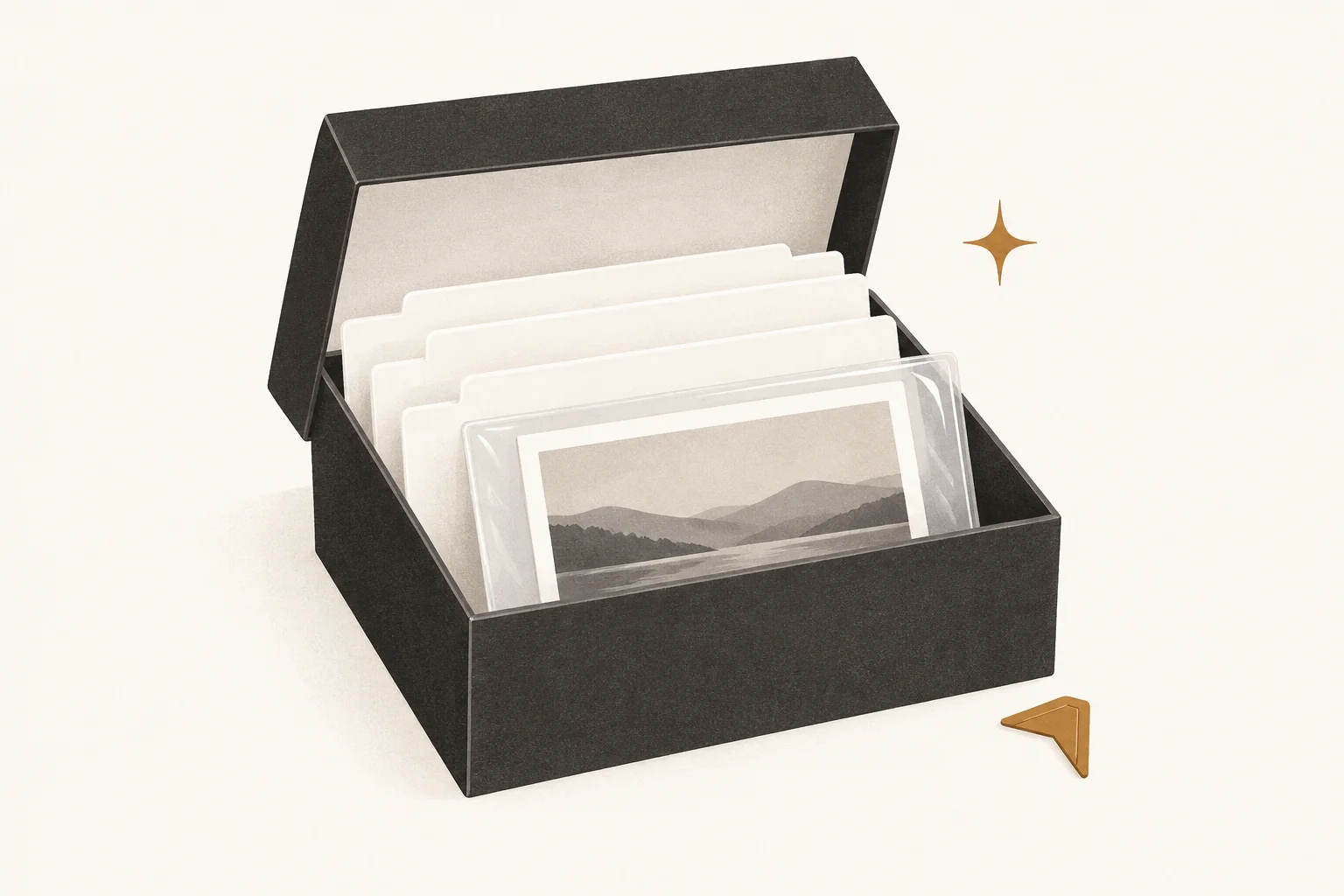
Acid-free, lignin-free, photo-safe, and archival are related labels, but they do not mean the same thing. Acid-free describes one property at one point in time. Lignin-free addresses a different source of paper deterioration. Photo-safe is most useful when a supplier identifies the relevant imaging-material standard and a passed Photographic Activity Test; archival by itself is often an undefined marketing word.
That is the short answer. The practical answer is to choose materials by documented composition, test evidence, construction, and fit for the specific photograph or keepsake—not by a single badge on the front of a package.
This matters most when a material will touch an original. A decorative page can be replaced; a unique photograph, letter, or recipe card cannot. Our guide to preserving photographs in a memorial scrapbook explains why using a copy in the book and storing the original separately is often the safest design decision.
The label is not the whole product
An album is a system. Paper, plastic, adhesive, ink, fasteners, dyes, coatings, seams, and storage conditions interact. An acid-free page does not make an unknown pressure-sensitive adhesive safe, and a stable sleeve does not protect a photograph from high humidity, heat, or direct light.
The Library of Congress notes that many enclosures are sold as “archival” or “acid-free,” but a fully evaluated photographic enclosure should meet the current imaging-material specifications, including the Photographic Activity Test (PAT). The National Archives similarly avoids recommending particular brands because manufacturers can change composition and vendors can change stock.
Treat a vague label as the start of a question:
- What material is this, exactly?
- Is it uncoated or does it contain plasticizers, dyes, or fillers?
- Has the complete product—or only a raw component—passed a relevant test?
- Is the adhesive applied to the original or only to the enclosure?
- Can the original be removed without solvents, heat, or force?
- Does the material suit this photographic process and storage environment?
Acid-free means pH is controlled, not that time has stopped
Acidity can weaken and discolor paper and can migrate from poor-quality housing materials into adjacent objects. Acid-free usually indicates that a paper or board has a neutral or alkaline pH when tested. It does not tell you everything about lignin, sulfur, dyes, coatings, adhesives, or how the material will age.
Some papers also contain an alkaline reserve, often called buffering, intended to neutralize acids that develop or migrate later. Buffered and unbuffered papers are not interchangeable for every photographic process. The National Archives points out that cyanotypes, blueprints, and some related materials can be sensitive to alkaline housing and may require neutral, unbuffered enclosures.
For ordinary family prints whose process is known and stable, a documented photo-safe enclosure from a preservation supplier is a reasonable preventive choice. For an unfamiliar nineteenth-century photograph, a blue image, a negative, or a chemically unstable object, the word “acid-free” is not enough to make the decision.
Lignin-free addresses a paper ingredient that can become acidic
Lignin is a natural component of wood. It contributes to the darkening and embrittlement familiar in newsprint and low-quality wood-pulp paper. Lignin-free or chemically purified pulp removes a major source of degradation, but it still does not describe every additive or the complete enclosure.
The Library of Congress recommends paper sleeves and envelopes that meet photographic specifications and contain no lignin, groundwood, or alum-rosin sizing. Its matting and framing guidance calls for cotton rag or chemically purified, lignin-free wood pulp board and requires the board to pass the PAT when used with photographs.
When comparing paper products, look for:
- cotton rag or highly purified wood pulp;
- acid-free or pH-neutral/alkaline information;
- lignin-free or a documented low-lignin specification;
- colourants that will not bleed or transfer;
- an appropriate buffered or unbuffered option; and
- PAT evidence when the paper will house photographs.
A page can be lignin-free but still use an unsuitable adhesive. A box can be made from good board but use a problematic lining. Ask about the finished product, not just the paper stock.
Photo-safe should point to photographic compatibility testing
“Photo-safe” is meaningful when it points to ISO 18902 requirements for processed imaging materials and a passed ISO 18916 Photographic Activity Test. The PAT evaluates interactions that may cause image fading or staining under accelerated conditions. It does not predict an exact lifespan or certify that every storage condition will be safe.
The current ISO 18916:2025 standard defines the PAT for enclosure materials and states that passing the test alone does not make a material archival. Ask the supplier whether the specific product passed the PAT, whether the result applies to the current version, and whether any adhesive, ink, coating, or seam was included in the tested product.
PAT evidence is stronger than an undefined icon, but it is not a universal guarantee. A smooth plastic sleeve can still trap moisture or allow a softened emulsion to stick in high humidity. A chemically suitable enclosure can still bend an oversized print or abrade a flaking surface.
Archival is a goal, not a regulated lifetime claim
The word archival may signal that a maker designed a product for long-term storage. On its own, it does not identify a material, standard, test, expected environment, or number of years. “Museum quality,” “preservation quality,” and “conservation grade” also need supporting specifications.
Do not ask, “Is this archival?” Ask:
- What is the paper or plastic made from?
- Which standard or test does the supplier cite?
- Does the documentation name the exact item or product line?
- Is the attachment non-adhesive or readily removable?
- Are there coatings, plasticizers, dyes, fillers, or unknown adhesives?
- What humidity, temperature, and handling limits apply?
No responsible seller can promise that an album will preserve every object permanently. Materials age, environments change, and family keepsakes combine inks, papers, photographs, metals, fabric, and adhesives with different needs.
Which clear plastics are usually suitable for photographs?
For many stable photographic prints in a moderate environment, preservation guidance commonly accepts uncoated polyester, polyethylene, and polypropylene. These plastics are not identical, and the exact formulation and surface treatment still matter.
| Plastic | General use | What to verify |
|---|---|---|
| Polyester | Clear, relatively rigid sleeves and encapsulation materials | Uncoated product, PAT evidence, no frosted abrasive surface |
| Polyethylene | Flexible sleeves, bags, and photo corners | Pure, uncoated material; adequate physical support |
| Polypropylene | Sleeves, pages, and boxes | Uncoated material; PAT evidence where it contacts photographs |
| Polyvinyl chloride (PVC) | Common in flexible consumer plastics | Avoid for valuable photographs and long-term housing |
The National Archives warns that PVC can generate acids, stick to items, and transfer image material. Smell or flexibility is not a reliable home identification method, so buy materials with explicit composition from a supplier that provides technical documentation.
Plastic has environmental limits. The Library of Congress warns that photographic emulsions may stick to smooth plastic at high relative humidity. Paper enclosures can be a better choice where humidity control is poor, for some unstable films, or when a surface is flaking. Clear sleeves reduce handling because the image can be viewed without removal, while opaque paper reduces light exposure. The right choice depends on the object and room.
Reversibility is a practical test for mounting decisions
For a family memory book, the safest attachment usually keeps adhesive off the original. The National Archives recommends acid-free paper or stable plastic corners and sleeves and warns against unknown glues, rubber cement, hot glue, pressure-sensitive tape, and self-stick “magnetic” album pages.
Reversible does not mean “I can probably peel it off.” It means a future person can remove the attachment without unacceptable change to the item, using a known method. Even adhesives used in conservation require material knowledge and skill.
Use this order of preference for ordinary, stable family materials:
- Put a high-quality copy in the book and store the original separately.
- Use photo corners or a suitable pocket that does not apply adhesive to the original.
- Use an enclosure or mount designed for the object’s size and weight.
- Reserve direct adhesive work for a conservator or for replaceable copies.
The Library of Congress describes wheat-starch paste and Japanese-paper hinges in professional preservation contexts, but its hinging guide cautions that moisture and technique require conservation experience. That is not a cue to learn on an irreplaceable photograph.
Pens and inks need evidence too
“Archival pen” is another incomplete label. A pen used on an enclosure or scrapbook copy should be resistant to fading, water, and transfer, but the safest way to label an original photograph is usually to label its enclosure first.
NARA recommends a No. 2 or softer pencil for paper enclosures. When an original paper print must be marked, it advises a light notation along the reverse edge rather than the image area. Resin-coated backs may require a suitable waterproof, fade-resistant, non-acidic pen, but test on a comparable expendable surface and follow preservation guidance.
Never use a pen because it writes smoothly on plastic if the ink can offset onto a photograph. Label the enclosure before inserting the object, and keep the writing away from seams that could contact the image layer.
A buyer’s checklist for albums, sleeves, paper, and boxes
Before buying, save or print the product documentation. Product pages change, and the evidence matters more than the marketing category.
For photograph sleeves and pocket pages
- The plastic is explicitly identified as uncoated polyester, polyethylene, or polypropylene.
- The specific product has passed the PAT, not merely “uses archival materials.”
- There is no PVC, unknown plasticizer, frosted abrasive surface, or pressure-sensitive adhesive touching the photograph.
- The pocket fits without bending, crowding, or sliding.
- The room is not routinely hot or humid.
For paper, dividers, corners, and boxes
- The paper is acid-free and lignin-free or made from cotton rag/highly purified pulp.
- Buffering is appropriate for the object; uncertain processes receive specialist advice.
- Dyes and inks are documented as non-bleeding.
- Photo-contact materials have PAT evidence.
- The box supports the contents without overfilling or allowing them to slump.
For albums and scrapbooks
- Pages can support the finished weight.
- The binding allows added thickness without crushing or distortion.
- Originals can be removed without peeling adhesive.
- Metal fasteners, rubber bands, office tape, and self-stick pages are absent.
- The closed album fits into a protective box and can be stored away from light.
Material choice is only one part of care. The guide to displaying and storing memorial scrapbooks and keepsakes covers light, handling, location, and access after the book is assembled.
For adhesives and mounting products
- No adhesive touches an irreplaceable original unless a conservator selected and applied it.
- Corners, pockets, or copies can accomplish the same reader-facing result.
- The supplier states the complete composition and relevant test evidence.
- “Repositionable” is not confused with conservation-grade reversibility.
When home preservation should stop
Preventive home care means careful handling, suitable enclosures, stable storage, copying for access, and documenting what you know. Conservation treatment changes or repairs the object and requires training.
Stop and consult a photograph, paper, or book conservator when you see:
- active mold, water or fire damage, or a strong vinegar-like film odor;
- flaking, powdering, blistering, or an image stuck to glass;
- brittle pages, fused photographs, or adhesives that resist gentle movement;
- cased photographs, glass plates, nitrate or acetate negatives, or unknown early processes;
- valuable originals that need cleaning, flattening, separation, or tape removal; or
- a mixed-media album whose parts appear to damage one another.
Do not use water, heat, solvents, household cleaners, erasers, or adhesive removers on an original. The American Institute for Conservation offers a directory for finding an appropriate professional.
Key takeaways
- Acid-free is one property: Also check lignin, dyes, coatings, adhesives, construction, and intended use.
- Photo-safe needs evidence: Look for the current product’s compliance with relevant standards and a passed PAT.
- Stable plastics are specific: Uncoated polyester, polyethylene, and polypropylene are common choices; avoid PVC and unknown plastics.
- Removal matters: Prefer copies, corners, sleeves, and pockets over direct adhesive on originals.
- Environment still governs risk: Even suitable materials cannot compensate for high humidity, heat, light, flooding, or rough handling.
- No material guarantees permanence: Inspect the collection periodically and update storage decisions as conditions and knowledge change.
Your next manageable step
Choose one product that currently touches an original photograph. Find its exact composition and PAT documentation. If you cannot verify either, do not panic or pull a fragile item apart. Place the album or enclosure in a clean, stable location, make an access photograph if safe, and plan a careful replacement or professional assessment.
The strongest preservation choice is rarely the package with the largest “archival” badge. It is the choice with the clearest evidence, the least irreversible contact, and the best fit for the specific object in front of you.