
How to Display and Store Memorial Scrapbooks and Keepsakes
A preservation-led plan for using, displaying, boxing, shelving, and backing up a memorial scrapbook without making the original inaccessible.
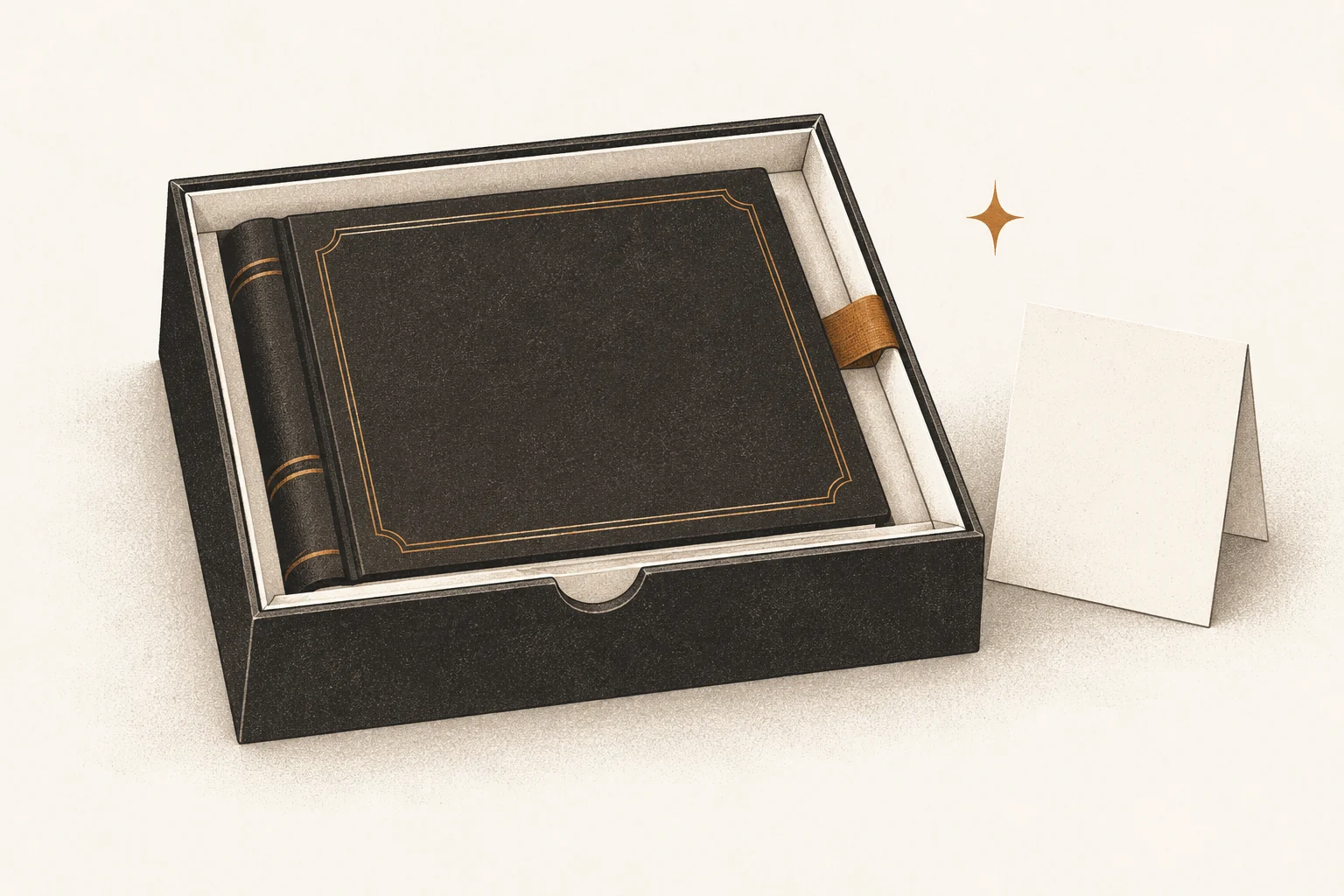
To display and store memorial scrapbooks and keepsakes, separate access from long-term protection. Keep the original book in a stable living-area closet or cabinet, preferably flat in a fitted preservation-quality box. Use a copy, scan, or short rotating display when you want the contents visible.
Light, handling, water, pests, unstable temperature and humidity, and a strained binding can all cause damage. No household setup eliminates every risk, so choose an arrangement you can inspect and maintain.
Difficulty: Beginner
Estimated setup time: 60–120 minutes
Ongoing check: Twice a year and after leaks, smoke, pests, or major weather events
Prerequisites: Clean hands, a clear work surface, and a temporary safe place for loose items
A good stopping point: Move the book away from direct light, food, water, and floor-level storage
What you will need
- A clean, dry shelf or closet in a frequently used part of the home
- A well-fitting preservation-quality box or wrapper
- Stable paper or inert plastic sleeves for loose items
- A pencil and an inventory sheet
- A support for temporary open display, if the binding can tolerate it
- Digital access copies and a tested backup location
Do not buy enclosures based on the word “archival” alone. The guide to acid-free, lignin-free, photo-safe, and archival claims explains what those labels do and do not establish.
Quick overview
| Step | Action | Why it matters |
|---|---|---|
| 1 | Check the book’s condition | Prevents handling from worsening existing damage |
| 2 | Choose one safe storage location | Reduces light, water, heat, and humidity risks |
| 3 | Support and enclose the book | Limits dust, abrasion, loss, and binding strain |
| 4 | Separate loose and incompatible items | Keeps objects from pressing, staining, or snagging pages |
| 5 | Create an access copy | Lets people view the story with less wear on the original |
| 6 | Display briefly and with support | Balances visibility with cumulative light and structural risk |
| 7 | Add privacy and disaster planning | Protects both the object and the people represented |
| 8 | Inspect and document changes | Finds problems while they are still manageable |
Step 1: Check condition before moving or opening the book
Place the scrapbook on a clean table with enough room to support the whole cover. Look for:
- a loose or detached cover;
- brittle, cracked, sticky, or flaking pages;
- photographs lifting from mounts;
- bulging pages or an overfilled binding;
- active mold, insects, droppings, or a strong musty smell;
- rusting fasteners, rubber bands, pressure-sensitive tape, or leaking plastic; and
- dampness, tide lines, soot, or fresh water damage.
Do not force the book flat. The Library of Congress advises supporting the binding and entire leaf, keeping food and drink away, and avoiding pressure that can detach mounted items. Its scrapbook and album care guidance also recommends conservation help when preventive care cannot address condition problems.
If pages are stuck, the book is wet or moldy, the binding is failing, or a valuable item is actively deteriorating, stop. Isolate it from unaffected material without disturbing mold or flakes, photograph the condition, and contact a qualified book, paper, photograph, or object conservator.
Warning: Do not use household cleaners, adhesive removers, lamination, or pressure to “fix” an unfamiliar material. A well-meant repair can be irreversible.
Step 2: Choose a stable storage location in the living area
A practical household location is usually an interior closet or enclosed cabinet in a regularly occupied room. Choose a shelf:
- away from direct sunlight and strong display lighting;
- away from plumbing, exterior leaks, radiators, fireplaces, vents, and cooking fumes;
- above floor level and below overhead water sources when possible;
- outside attics, garages, sheds, and damp basements; and
- accessible enough that someone will notice a leak, pest, or odour.
The National Archives recommends cooler, drier conditions for family papers and photographs and warns against high humidity, very low humidity, and unstable environments. Its family archive storage guidance provides useful limits, but a normal home will fluctuate. Stability and avoiding extremes matter more than trying to create a museum vault with unverified equipment.
Do not seal a damp item in plastic. If the room has recurring condensation, leaks, or mold, solve the building problem before upgrading boxes.
Step 3: Support the scrapbook and use a fitted enclosure
The current Library of Congress personal guidance recommends storing albums flat in a well-fitting preservation-quality box to protect them from light, dust, and pests. The Northeast Document Conservation Center similarly recommends flat storage for scrapbooks, usually singly or in stacks of two, because mixed materials and bulky additions strain bindings.
Use these practical rules:
- Measure the book at its widest, tallest, and thickest points without compressing it.
- Choose a box that supports the whole book without squeezing decorations or allowing it to slide.
- Place the box flat on a shelf deep enough to support its full footprint.
- Do not stack heavy boxes on top.
- Label the box and shelf location in pencil or on a removable exterior label.
Small, structurally sound books may sometimes stand upright with similar-size volumes and full support, but flat boxing is the safer default for a heavy, irregular, damaged, or overfilled scrapbook. Do not let a large album extend over the shelf edge.
The NEDCC storage and handling guidance notes that scrapbook components and three-dimensional decoration make these books unusually vulnerable. If the binding is already strained, do not solve the problem by tightening a strap around it.
Step 4: Store loose keepsakes by material and size
A medal, dried flower, textile, newspaper clipping, optical disc, and photograph do not share the same storage needs. Thick or hard objects can emboss nearby pages; acidic or unstable materials can stain them; loose edges can snag.
For each loose item:
- assign an inventory number;
- record what it is, who supplied it, and where it relates to the book;
- photograph both sides;
- place it in an appropriate individual enclosure; and
- add a copy or a labelled reference card to the scrapbook page.
Use stable paper envelopes or folders for many paper items and inert polyester, polyethylene, or polypropylene sleeves when visibility is useful and the material is suitable. Avoid polyvinyl chloride (PVC), office-quality plastic, rubber bands, sticky notes, and untested self-adhesive pockets.
For photographs, the National Archives recommends handling by the edges, using appropriate sleeves or paper enclosures, and not trying to detach images from mounts or album pages. Review its photograph handling guidance before rehousing originals.
The keepsake-selection guide can help decide whether to mount a copy, store an original separately, or represent a three-dimensional object with photographs and a caption.
Step 5: Make an access copy before the original becomes fragile
An access copy can be a set of page photographs, a PDF, a printed facsimile, or a duplicate book. It reduces repeated handling and makes sharing easier, but it does not replace the original or its backup record.
Before digitizing:
- number pages lightly in a separate inventory if sequence is unclear;
- support the book so it opens only as far as it does comfortably;
- use an overhead camera for a fragile or tightly bound volume;
- include colour and scale references when accurate reproduction matters;
- capture covers, blank pages with annotations, inserts, and detached pieces; and
- check every file before returning the book to storage.
Do not press a thick, brittle, or tightly bound scrapbook onto a flatbed scanner. The goal is a usable record without trading access for structural damage.
Keep master captures, smaller sharing copies, captions, and the page inventory together. Follow the 3-2-1 backup guide so the digital copy does not exist on only one phone or computer.
Step 6: Display copies freely and originals sparingly
Light damage accumulates and cannot be reversed. The Library of Congress light-damage guidance classifies many colour and digital photographs, coloured papers, inks, and other common scrapbook materials as highly light-sensitive. Exact safe exposure depends on the material, light level, and duration.
For a home display:
- place a facsimile or reprint in permanent view;
- keep originals out of direct sun and away from spotlights;
- limit how long an original is displayed;
- rotate pages or objects instead of leaving one exposed;
- use a support that holds the entire book at a gentle angle; and
- never force the binding open or use clips, pins, tape, or weights on pages.
NEDCC advises that light damage is cumulative and permanent and that an open volume needs full support from a cradle or wedge. Its exhibition guidance recommends copies or facsimiles whenever possible.
UV-filtering glazing can reduce part of the risk for a framed item, but it does not make permanent display harmless. Heat, visible light, humidity, pollutants, mounting materials, and physical security still matter.
Tip: Create a “story of the month” display using a reprint, a short caption, and a QR code or family link to the access copy. Keep the original in its box.
Step 7: Plan for handling, privacy, and emergencies
Write a one-page use note and keep a copy outside the storage box. Include:
- clean, dry hands and a clear table;
- no food, drink, pens, lotions, or hand sanitizer near the book;
- support instructions and the maximum comfortable opening angle;
- which pages or inserts are loose;
- which materials are private or restricted;
- the location of the access copy and backup; and
- who to contact after water, fire, mold, pest, or handling damage.
Privacy matters even when the physical book stays at home. A digitized copy may expose addresses, children’s images, private correspondence, health information, or stories that contributors limited to one audience. Store restricted pages separately or limit access in the sharing copy.
Reduce disaster risk before buying special equipment. Keep the box off the floor, know which pipes and windows are nearby, do not store it below roof leaks, and keep an inventory with current photographs. If material becomes wet, do not separate stuck photographs or dry a large collection without advice; response choices depend on the materials and scale.
Step 8: Inspect without overhandling
Check the storage area and exterior of the enclosure every six months. Open the book only as much as needed and compare with earlier condition photographs.
Look for:
- a new smell, condensation, mold, insects, or droppings;
- fading, yellowing, tackiness, corrosion, or stains;
- detached items, tears, or increased binding strain;
- dust or debris entering the box;
- a box that has warped, become wet, or no longer fits; and
- missing or inaccessible digital backups.
Record the date, findings, and any action. Do not perform a repair merely to complete the checklist. “No change; returned to shelf” is a useful record.
Troubleshooting common storage and display problems
The scrapbook is too thick to close
Do not compress it. Number and photograph the loose or bulky pieces, store them in appropriate separate enclosures, and place reference cards where they belonged. Seek a conservator’s advice if removing material would damage the original arrangement.
Family members want the book visible every day
Display a high-quality copy or selected reprints. Schedule supervised viewing of the original on a clean, supported surface.
The only available storage is a basement or attic
Choose a living-area cabinet or closet first, even if it is less spacious. If no stable location exists, prioritize a fitted box, elevation from the floor, leak detection, periodic checks, an access copy, and off-site digital backup while you seek a better location.
A frame says it blocks UV
Treat that as one control, not permission for permanent display. Keep the item out of direct sunlight, use preservation-quality mounting, limit exposure time, and retain a condition photograph.
An item is moldy or smells musty
Separate it from unaffected materials, avoid brushing or cleaning it in the home, and seek professional advice. Mold can affect health and spread to nearby items.
Frequently asked questions
Should every scrapbook be stored flat?
Flat storage is the safest default for heavy, damaged, oversized, overfilled, or irregular scrapbooks. A small sound volume may stand upright with proper support, but a fitted flat box reduces several household risks.
Can I put photographs in plastic sleeves?
Use only suitable, inert plastics such as uncoated polyester, polyethylene, or polypropylene when appropriate for the item. Avoid PVC and unknown plastics. A damaged, flaking, or sticky photograph may require professional advice.
Is an “acid-free” cardboard box enough?
Not necessarily. Fit, construction, lignin content, adhesives, buffering, and suitability for photographs also matter. Buy from a preservation supplier that states material specifications.
Should I wear gloves?
For a scrapbook’s paper pages, clean and thoroughly dry hands often provide better control. Individual photographs may benefit from clean nitrile gloves and edge handling. Follow the needs of the material and avoid cotton gloves if they reduce dexterity.
Does digitizing the book mean I can discard it?
No. A digital image does not preserve the book’s materials, construction, scale, texture, annotations, or all evidence on the object. Keep the original when it is safe and appropriate, and treat the copy as access and risk reduction.
Your next manageable step
Move the scrapbook to a clear interior shelf above floor level, away from sunlight, plumbing, vents, food, and drinks. Photograph its closed condition, write down the shelf location, and identify one enclosure or access-copy task to complete next.
Good care should make the book usable, not invisible. A protected original, a convenient copy, and a simple inspection record give the family both access now and better evidence for future decisions.